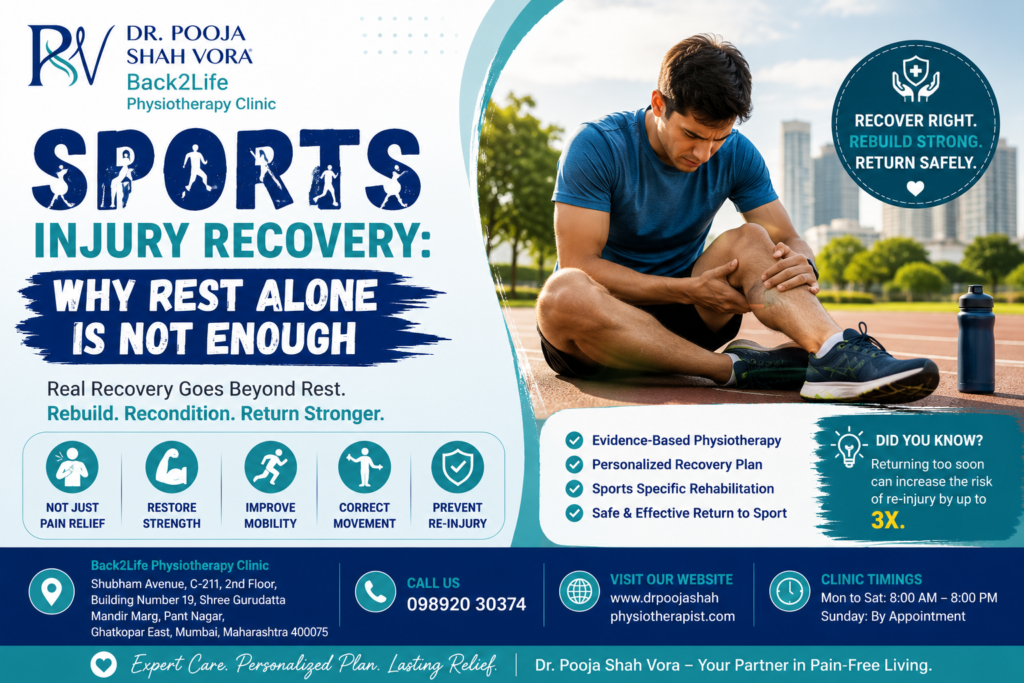
Sports Injury Recovery: Why Rest Alone Is Not Enough
One of the biggest mistakes athletes, fitness enthusiasts, runners, gym-goers, and active individuals make after an injury is assuming that rest by itself will solve the problem. While temporary rest can sometimes help calm irritation, it usually does not address the full reason the injury happened or what the body now needs to recover well.
At Back2Life Physiotherapy Clinic, Dr. Pooja Shah Vora supports sports injury recovery with a focus on pain relief, movement restoration, flexibility, strength, load management, and a safer return to physical activity. The goal is not just to reduce pain, but to help the body recover properly and reduce the risk of recurrence.
- Support for muscle, ligament, joint, and movement-related sports injuries
- Guided rehab beyond simple rest
- Return-to-activity planning with physiotherapy
- Focus on recovery, movement quality, and recurrence prevention
Recovery Beyond Rest
Sports injury recovery usually needs more than just stopping activity. It often requires guided rehabilitation and movement correction.
Strength & Control
Recovery is often stronger when the body regains muscle support, balance, control, and load tolerance.
Movement Quality
Physiotherapy may help address the movement patterns that contributed to the injury in the first place.
Safer Return to Activity
Returning too soon or too weak can increase recurrence risk. A structured return plan matters.
Why Rest Alone Is Often Not Enough in Sports Injury Recovery
Rest can sometimes reduce pain in the short term because it lowers irritation and removes the immediate load from the injured area. But pain reduction alone does not always mean true recovery. If flexibility, strength, balance, movement control, tissue tolerance, or technique problems remain unaddressed, the same pain often returns as soon as activity restarts.
This is one of the most common reasons people feel better for a few days or weeks and then experience the same problem again when they go back to running, gym training, football, cricket, badminton, cycling, dance, yoga, or regular exercise.
The real goal in sports injury recovery is not just “no pain while resting.” It is being able to move, load, train, and function better with improved tissue support, movement quality, and confidence.
Common Sports and Activity-Related Injuries Seen in Physiotherapy
Sports injuries are not limited to professional athletes. Recreational runners, gym-goers, school and college players, weekend fitness enthusiasts, and people doing regular sports or workouts can all develop movement-related injuries. Common problems may include:
Muscle Strains
Often seen in the hamstrings, calves, quadriceps, shoulders, back, or groin after sudden overload or inadequate control.
Ligament Sprains
Common around the ankle, knee, or wrist when joints are stressed beyond normal range or stability.
Overuse Injuries
Repeated training load without sufficient recovery may contribute to persistent pain and reduced performance.
Tendon Irritation
Tendons may become painful when load capacity and activity demands are not balanced properly.
Joint Pain During Activity
Pain may develop in the shoulder, knee, ankle, hip, or back because of movement inefficiency or poor support.
Reduced Mobility After Injury
Even when pain reduces, stiffness and guarded movement can remain unless rehabilitation is done properly.
What Rest Can Do — and What It Cannot Do
Rest is not useless. In some cases, a short period of reduced activity can help calm acute pain, swelling, or irritation. But rest has limitations.
| What Rest May Help With | What Rest Usually Does Not Fix by Itself |
|---|---|
| Reducing immediate irritation | Movement errors or technique problems |
| Giving tissues temporary relief | Muscle weakness or poor joint support |
| Helping calm pain in the early phase | Reduced flexibility or stiffness after injury |
| Lowering stress on the painful area | Balance deficits or lack of control |
| Allowing short-term symptom reduction | Safe return-to-sport readiness |
This is why people who rely only on rest often feel better temporarily but do not actually rebuild the body’s readiness to handle movement and load again.
How Physiotherapy Supports Better Sports Injury Recovery
Physiotherapy usually helps by addressing both symptoms and the functional reasons behind the injury. Recovery is stronger when pain relief is combined with mobility work, strengthening, correction of movement patterns, and progression back to activity.
1. Assessment of the Injury and Movement Pattern
A physiotherapy assessment may look at the injured area, surrounding muscle support, posture, flexibility, balance, joint movement, and activity demands. This helps guide what kind of recovery plan is appropriate.
2. Mobility and Flexibility Restoration
Many injuries lead to stiffness and guarded movement. Physiotherapy may include guided mobility work to help restore more natural movement patterns.
3. Strengthening the Right Support Systems
Recovery often requires rebuilding strength not only in the painful area but also in the surrounding muscles that help absorb load and control movement.
4. Balance, Coordination, and Control Training
Sports injuries are not always about “strength only.” Control, timing, coordination, and body awareness often play a major role in how the body handles stress.
5. Gradual Return to Activity
Instead of jumping straight back into full training, physiotherapy may help create a structured step-by-step return plan based on tolerance and progress.
6. Recurrence Prevention
Better recovery means lowering the chance that the same problem will come back when the person resumes training or sport.
Signs That Rest Alone Is Not Enough
A sports injury usually needs more than rest when:
- Pain returns as soon as you restart exercise
- The area still feels weak, stiff, or unstable
- Movement confidence is reduced
- You are avoiding certain drills, stretches, or positions
- Training form has changed because of the injury
- The same problem has occurred more than once
- You are unsure how to safely get back to sport
If you can rest without pain but cannot move or train well without pain, recovery is not complete yet.
What a Better Sports Injury Recovery Plan May Include
A good recovery plan is usually based on the injury type, severity, sport, fitness level, and current function. It may include:
Pain-guided load modification
Reducing excess strain without becoming completely inactive for too long.
Mobility and tissue support
Helping restore range of motion and reduce stiffness or compensations.
Targeted strengthening
Improving the injured area and the surrounding support system together.
Movement correction
Addressing technique or body mechanics that may have contributed to the injury.
Balance and neuromuscular training
Supporting better control, confidence, and sport-specific readiness.
Return-to-sport progression
Helping the person move from basic recovery to real activity tolerance safely.
Why Re-Injury Happens So Often
Re-injury often happens when the painful tissue feels better before the body is truly ready for full activity again. Pain may reduce earlier than strength, control, tolerance, and movement quality return. This gap creates a false sense of readiness.
Common reasons for recurrence include:
- Returning too quickly to full training
- Skipping rehabilitation exercises
- Ignoring weakness or stiffness
- Poor warm-up or load progression
- Continuing faulty movement mechanics
- Not rebuilding endurance and control
Who May Benefit from Sports Injury Physiotherapy?
Physiotherapy may be useful for:
- Recreational athletes
- Gym-goers and fitness enthusiasts
- Runners and cyclists
- Cricket, football, badminton, tennis, and basketball players
- Dancers and yoga practitioners
- People with repeated training-related pain or strain
- Anyone who wants a safer return to physical activity after injury
What to Expect During Sports Injury Physiotherapy
At Back2Life Physiotherapy Clinic, sports injury recovery may begin with understanding the injury history, activity demands, pain pattern, movement limitation, and current function. Depending on the assessment, rehabilitation may include:
Assessment
Looking at pain pattern, flexibility, strength, control, movement quality, and activity needs.
Early Recovery Support
Reducing irritation and guiding symptom-friendly movement in the first stage.
Rehabilitation Progression
Gradual work on mobility, strength, balance, and sport-related function.
Return Plan
Helping the person move back toward training and activity with better readiness.
Why Choose Dr. Pooja Shah Vora for Sports Injury Recovery?
Sports injury recovery usually works best when the goal is not only symptom relief, but functional recovery. That means understanding the body’s current limitations, rebuilding support, and helping the person get back to activity more confidently and safely.
- Patient-focused physiotherapy approach
- Support for movement recovery and rehab progression
- Focus on strength, mobility, and functional return
- Guidance aimed at reducing recurrence risk
- Convenient clinic access in Ghatkopar East
Looking for Sports Injury Physiotherapy in Ghatkopar?
If you are searching for terms like sports injury physiotherapy in Ghatkopar, sports rehab in Ghatkopar, physiotherapy for sports injury recovery, sports injury treatment in Ghatkopar, or return to sports physiotherapy, this page is designed to help you understand why proper rehab matters more than rest alone.
Back2Life Physiotherapy Clinic is based in Ghatkopar East and supports patients looking for structured sports injury recovery guidance in the local area.
Frequently Asked Questions
Book a Consultation for Sports Injury Recovery in Ghatkopar
If your pain keeps returning when you try to get back to activity, or if rest has helped only temporarily, a structured physiotherapy assessment can help you understand what your recovery is still missing.